Tails don't wag, dogs do
Knowing what you can and can't control helps manage expectations. Over time, you can look for ways to incorporate some of these factors into your circle of influence.

Asking the testing department to shift left or improve quality is like asking a dog's tail to be responsible for wagging. While tails do an excellent job of the mechanics of wagging, it's a dog's brain that controls the activity.
In the same way, software testing is fundamentally an activity constrained and resourced by product owners and engineering leadership. Software testing rarely wags its tail for its own delight and instead serves a purpose dictated by others.
Quality at senior leadership
This is why it is so important that there are advocates for quality at the leadership level. People who can explain the how and the way of software testing. People who can advocate for more time, budget, and engineering ownership.
This person can have any title or role, but the more senior, the better. For instance, they could be a product owner or head of engineering. In some cases, it's a senior quality professional who performs this role—someone who is on par with other senior engineering leaders. It doesn't have to be; it could be engineering or product leaders who are passionate and understand the nuances of quality beyond "automate all the things".
Leaders must own Quality too
Unfortunately, I frequently see companies putting the responsibility on team-level Quality Coaches to somehow improve quality with little support from engineering. While they agree to the concept that everyone owns quality, it somehow seems to escape them that they, too, must stump up and show the importance of quality through action.
Instead, quality coaches are faced with the almost impossible task of improving quality within a team with little or no support from engineering and product leadership and constraints a quality coach has no control over. Teams incentivised to deliver features regardless of quality are not going to suddenly want to slow down to improve their unit test coverage. Teams with little agency over their time and choice of activity are simply unable to take on new work no matter how passionate they are about quality.
It doesn't have to be this way, though. Engineering leadership need to recognise the gap in their skillset and either fill it or hire a senior quality person to help coach them on what is required. I feel one of the key roles of a senior quality professional is giving senior engineering and product leadership the necessary information to make informed choices about how much and where to invest in quality.
Focus on what you can control
This doesn't mean that as a quality coach, you should give up trying to impact and improve how teams think about quality. There's lots of value in working with teams, and there's always something that can be done, be it more exploratory testing, increased monitoring and/or synthetics in production.
Communicating what you can be accountable for is one of the tricky parts of being a quality coach. Understanding and being aware of what you can control, can influence, and can't control helps you manage your and others' expectations around the role.
The circle of control is one useful way to think about the quality coach role.
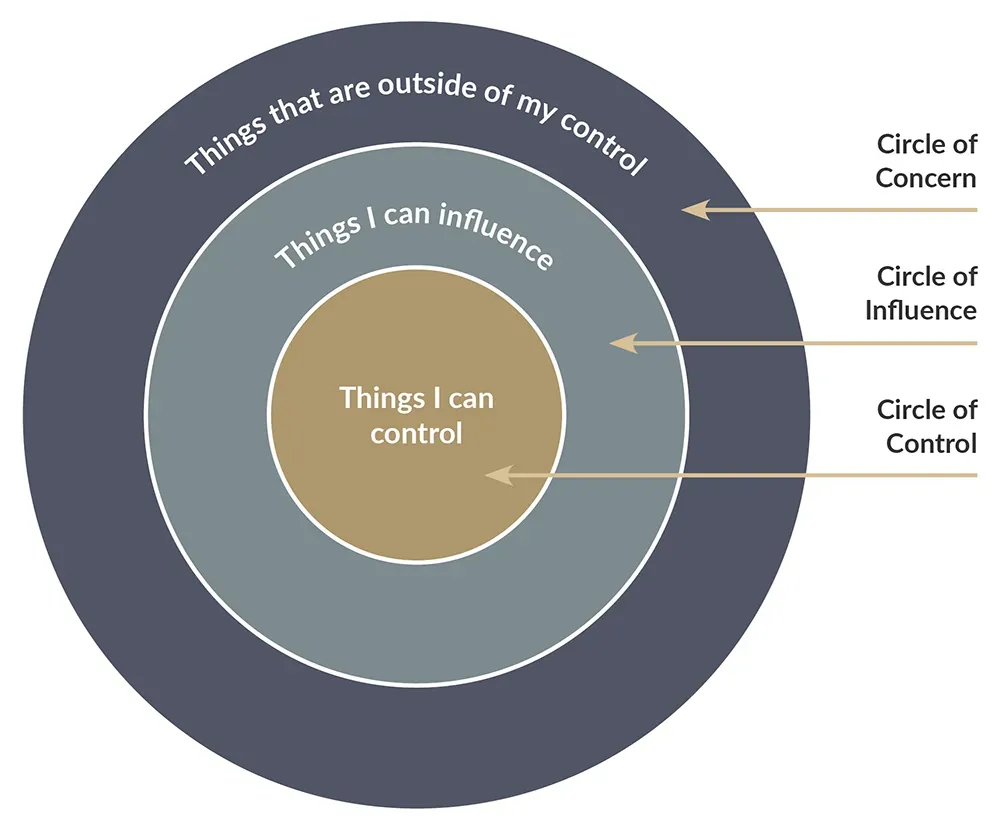
Circle of Control
The first and smallest circle at the center is the circle of control, representing aspects of our life over which we have direct control. It is the sphere in which we can effect change. The circle of control symbolizes the areas where we can take meaningful action and make a positive difference.1
As a quality coach, what are the things you can control? Where can you effect change? What can you take "meaningful action and make a positive difference"?
For example, it might be:
- working within the given time and constraints a team has
- your facilitation skills
- your coaching approach
- what you chose to coach on (test automation, monitoring alerting, pairing and collaboration, risk-based activities)
- how much you communicate and to whom
- how much you involve yourself in the testing activities
- how you respond when teams reject ideas and support
Circle of Influence
The second circle is the circle of influence, described as the 'grey zone'. How much we can change things, depends on how much power we have within the organisation.
We may or may not have the power to expand our influence into this region to create change. We can certainly try. It is wise to spend some of our energy in that sphere, bearing in mind that we can control our efforts in this sphere, but not necessarily outcomes.1
As a quality coach, it's worth reflecting on what you believe you can and cannot influence. You may be able to influence a team to:
- try a new testing approach such as exploratory testing
- improve their test automation strategy
- increase test coverage
- improve monitoring and alerting
- refine their critical user journeys
- perform risk-storming or event mapping
- how to measure quality
- teams' engineering and collaboration practices
But, you may not. After all, the team owns and is responsible for quality and may choose not to be 'influenced' by you. Teams may not be in a position to act on your advice, or they may fail to see the value you offer. It doesn't mean you shouldn't try to influence, but be realistic about the outcome.
You can control how you respond to setbacks, though. Seeing quality improvement as a journey that everyone goes through, and these setbacks are to be expected helps me remain optimistic about the final outcome.
You can also control how you communicate your efforts. Is there someone you can inform of your efforts and seek advice on what to do next?
Circle of Concern
The circle of concern includes the events, situations, reactions, and phenomena that are clearly outside of our spheres of control and influence.1
As a quality coach working with one of two teams, you are often not in a position to influence change at a senior leadership level. That means it's likely you won't have control over:
- the product we are developing
- the budget allocated for quality
- how other teams operate and respond to your team's efforts
- the ability to determine how much time is invested in quality
- the amount of money invested in tooling for testing
- the number of quality coaches you hire
- senior leadership's willingness to own quality
It's useful to be aware of some of these factors. Knowing what you can't control helps you temper your expectations. You might even be able to use them to temper others' expectations of the role. And maybe in time, you can look out for ways some of these factors can be pulled into your circle of influence.
Create your Quality Coach Circle of Control
The University of Victoria created a template to create a circle of control as a job aid. I've modified this to create a template for a quality coach aid2.
Download this template to work out the quality coach circle of control for your work.
Further Reading & Reference
1 These quotes come from the article by Anna Katharina Schaffner, see below.
 Anna Katharina Schaffner, Ph.D.
2 I haven't tried this out myself. If you do, I would really like to hear about how it went and what you learned.
Got a decision to make, a conversation to prep, or a move to work out?
Drop in the real situation. KYM reads it through the Handbook's frameworks and gives you a move you can try.
Open Know Your Move →

Comments ()