Team Test Strategy Workshop for Quality Coaches
This workshop provides a systematic approach to developing a team test strategy for an epic or large feature. It provides a team with a framework within which they can consider all the factors that impact testing.
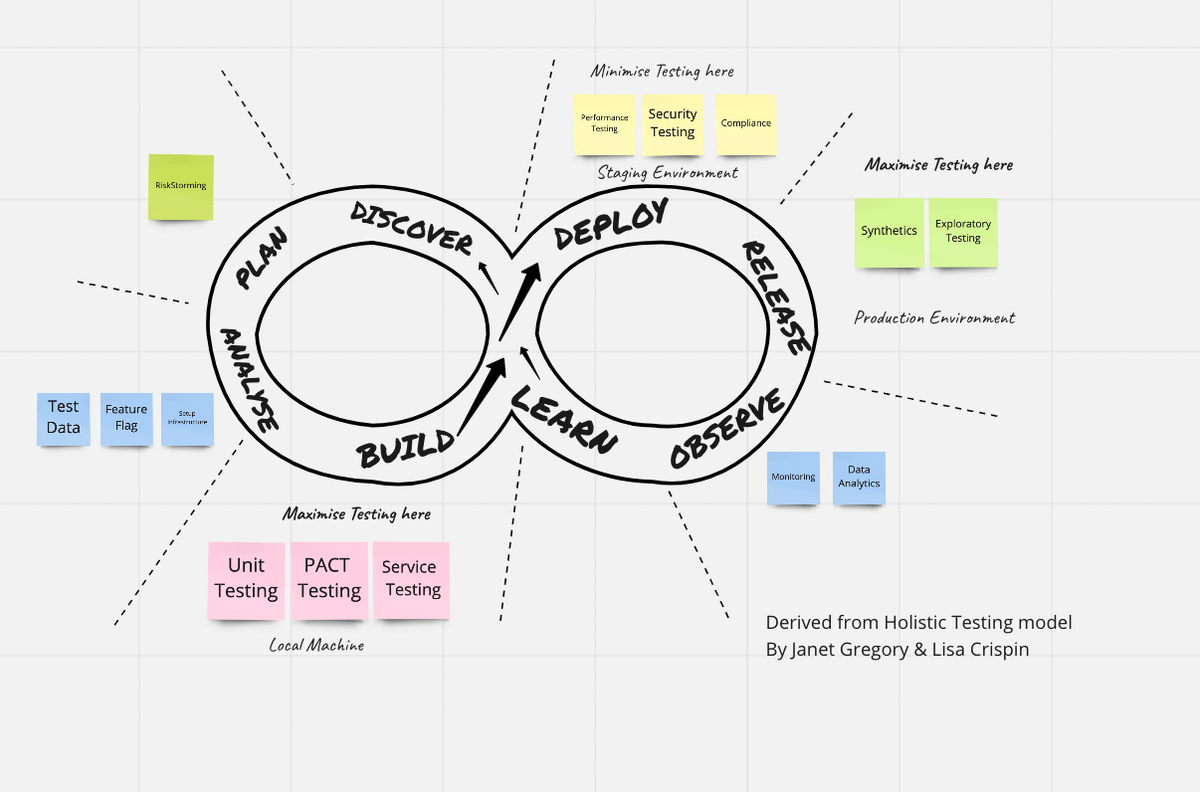
What is a Team Test strategy?
A Team Test Strategy frames and informs a team's testing. It provides clarity on the scope and types of testing to be performed. The scope of a test team strategy can include design and infrastructure considerations.
Benefits of Team-Based Test Strategies
It can be very rewarding for teams to develop testing strategies. The diversity of roles brings a more rounded scope, especially if designers and product owners are in the workshop. New ways to make testing more efficient are discovered. In my experience, my greatest source of learning comes from software developers bringing innovative solutions to the table.
Teams learn the subtleties and considerations required to test a feature. As a result, they can begin to better estimate testing time. Any coach will tell you that success is better achieved if teams have a say in the outcomes. A team-facilitated test strategy does this by holding a test strategy workshop.
Who owns the test strategy?
In the Quality Assistance model, where quality coaches assist teams in software testing and quality, the team is the custodian of the software test strategy.
The ultimate goal is for the team to dictate the software test strategy.
This online remote-first workshop provides a systematic approach to developing a team test strategy for an epic or large feature. It provides a team with a framework to consider all the factors that impact testing.
Market a Test Strategy workshop
Any new concept or ritual is a form of change1 for the team, so treat it as such. Introduce the idea and what it involves. Talk about its benefits in terms of reduced rework and more accurate test estimation.
Share articles and talks on the topic. For example, has another team started using test strategies and found them useful? Get them to speak to the team.
1ADKAR is a good model to help think about change management
Plan the Test Strategy workshop
Be intentional about your planning. I've broken the planning into three sections:
- The Feature/Epic to test
- Timing (Duration and when to run)
- A well-formulated meeting invite
Feature/Epic for the workshop
Ask the team what feature/Epic they want to use for the workshop. The ideal is a new feature to an existing familiar product. Avoid features that are massively complex and spread across multiple teams. If the team likes and thinks the concept is worthwhile, you can introduce more complex features.
Timing Considerations
Teams will want to know where this session sits within their delivery process. I would recommend somewhere in the planning phase, prior to estimations is ideal. This is because the test strategy will help inform test estimation.
Timebox the workshop to two hours. Explain that a test strategy may take time now, but as they improve, the amount o as they improvef time required will reduce.
Meeting invite
The 4P Meeting Management Model is useful to consider when intentionally planning meetings.
Purpose: <why the workshop will be held>
Product: <what the output will be>
Personal Benefit: <what will people get out of it>
Process: <how will it work>
I've provided a working example in the Test Strategy workshop pack.
Test Strategy Workshop Preparation
Collate as much data on the new feature as possible and share this at least a week before the workshop. Examples of information could be use cases, stories, persona, design specs, API's, definitions of done, and release process. Being familiar with context will help the team decide on value and risk.
Workshop Structure
The workshop is based on the Miro Board Team Test Strategy for Quality coaches
- Ask the team to review the Feature information, is it up to date? Has anything changed?
- Given the feature context, ask the team to describe the features' value and concerns they may have.
- Ask the team to consider how this feature impacts the rest of the system. This will inform what regression testing to perform.
- Use the value and risk analysis to inform the types of testing the team agrees to perform.
- Prioritise the types of testing. This can be useful if the scope of testing is enormous and the team is on a tight schedule.
- Identify when and who will perform the testing. Offer to check back with the team at regular points throughout testing.
In my team test strategy information pack, you will get slides that run you through this format with facilitation comments in the presenter notes.
Team Test Strategy Information Pack
Here is the information pack to download. It contains:
- Facilitation Instructions
- Miro Board Link
- Meeting Template
FAQ on this workshop
Q: What if the team's test strategy differs from my approach?
A: As much as possible, empower the team to decide on the testing types. Once that team has experimented with applying the testing strategy, you can hold a retro to explore how it went and what the team could do differently next time.
Q: What if the team doesn't know the solution or the technical depth as you described above?
A: Outline as much of what you DO know. Then base your test strategy on that. Agree to revisit the test strategy once more information becomes available.
Q: My team feels nervous about writing such a strategy. They've never done something like this before.
A: If your team feels uncertain and nervous about creating a test strategy, offer to write them the first one so they can see what it looks like.
Q: We're doing a second test strategy. Do I need to do the whole modelling again?
A: Once you have done a few strategies, you will see areas of your product and technical models that remain static. Consider developing static models you can constantly refer to rather than always re-analyse.
Q: As a quality coach I've not created a test strategy before. Does that matter?
A: I would be open with the team about your experience in this area. Instead approach the exercise as learning for all of you. Of course, you could always run through the exercise yourself first to familiarise yourself with the experience.
Final words
I've found the key is maintaining curiosity, keeping an open mind and allowing the team to own the decision-making as much as possible. Avoid fixating on your ideas of what the test strategy should include. On the other hand, if the team asks for your opinion, be upfront and offer it. Focus on asking questions that open up the conversation on testing and facilitating to ensure an agreed scope of work.
Try not to stress; you don't have to be perfect. Strategies are rarely fixed in stone and often need adjusting as you and your team face reality. So, when the dust settles, have a retrospective to figure out what worked and what to drop. Hopefully, your team will gain some valuable learnings from the experience and have insights you have not considered.
Happy learning!
Thanks to Areti Panou, Maaret Pyhäjärvi & Anne Colder for feedback on this workshop.



Comments ()