Situational Quality Coaching (when to coach, train & mentor)
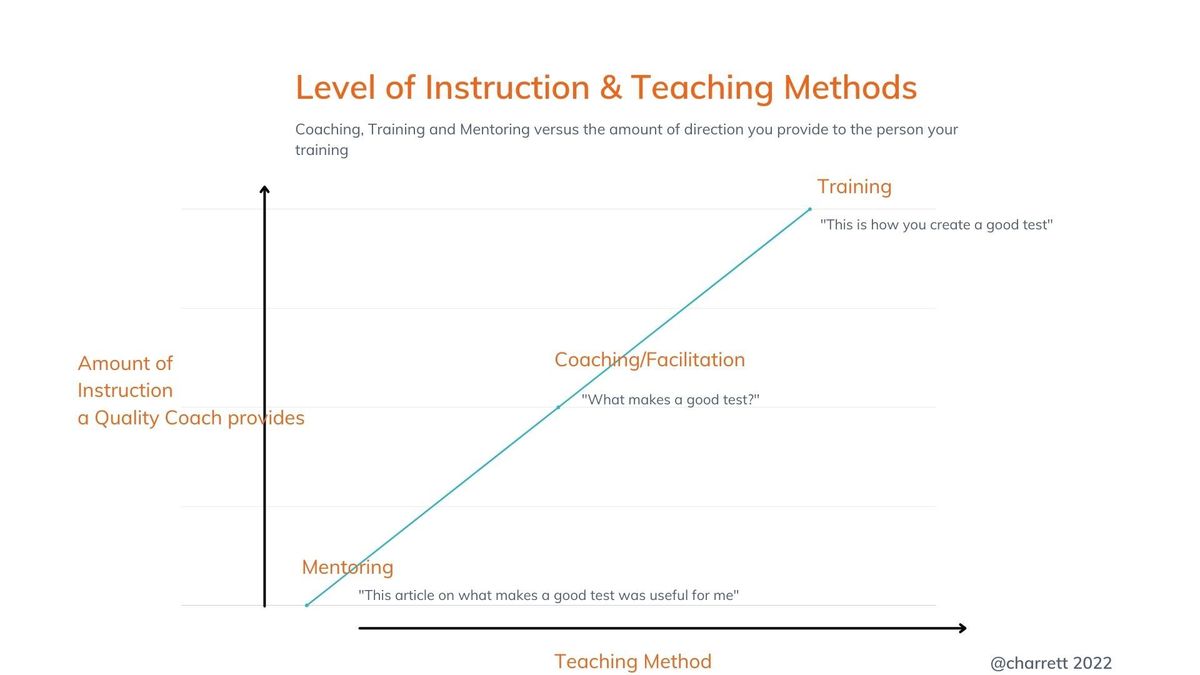
Fun fact, a quality coach doesn't only coach; they also mentor, train and facilitate1. This article explores when to coach, train, and mentor a product team on quality.
Coaching, Mentoring, Training
Coaching, Mentoring & training are different teaching methods and valuable parts of your quality coach makeup bag. Like many things in tech, knowing when to coach, when to train and when to mentor depends on the team, how experienced a quality coach is, and the nature of what is to be learned.
Imagine you wanted a product team to understand what makes a good test.
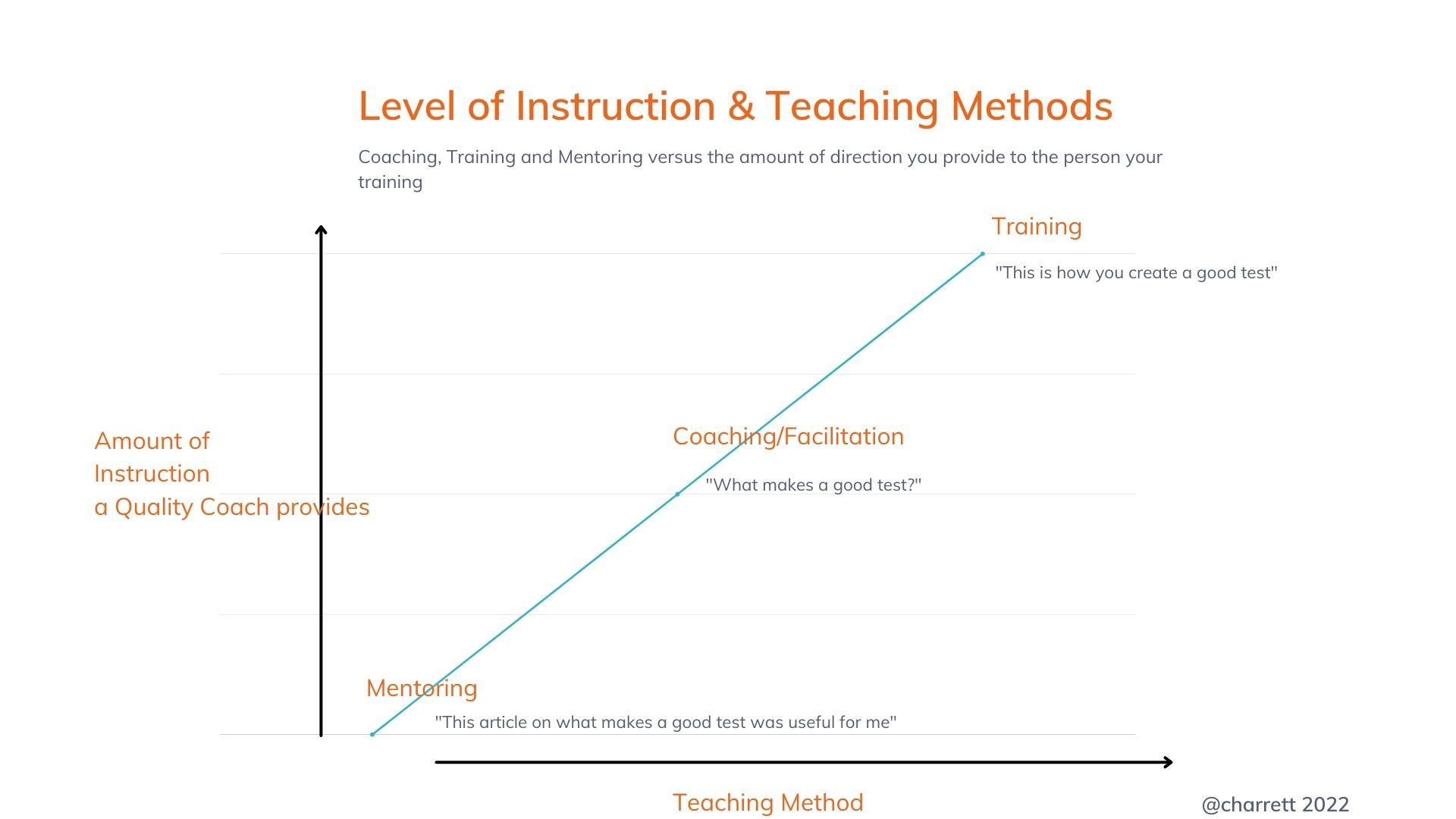
A mentor might say "here are some articles I've read on what makes a good test"
A coach might ask a team "what do you think are the elements of a good test?"
A trainer will deliver a session on "how to know what makes a good test"
All three methods allow the product team to learn the topic. The level of agency and the level of instruction are the core differences between the methods. When a quality coach teaches, they're instructing a team on how to perform a testing activity. When they mentor, they make content available, with the team choosing to use or not use the content. In coaching, they guide learning through the nature of the questions they ask the team.
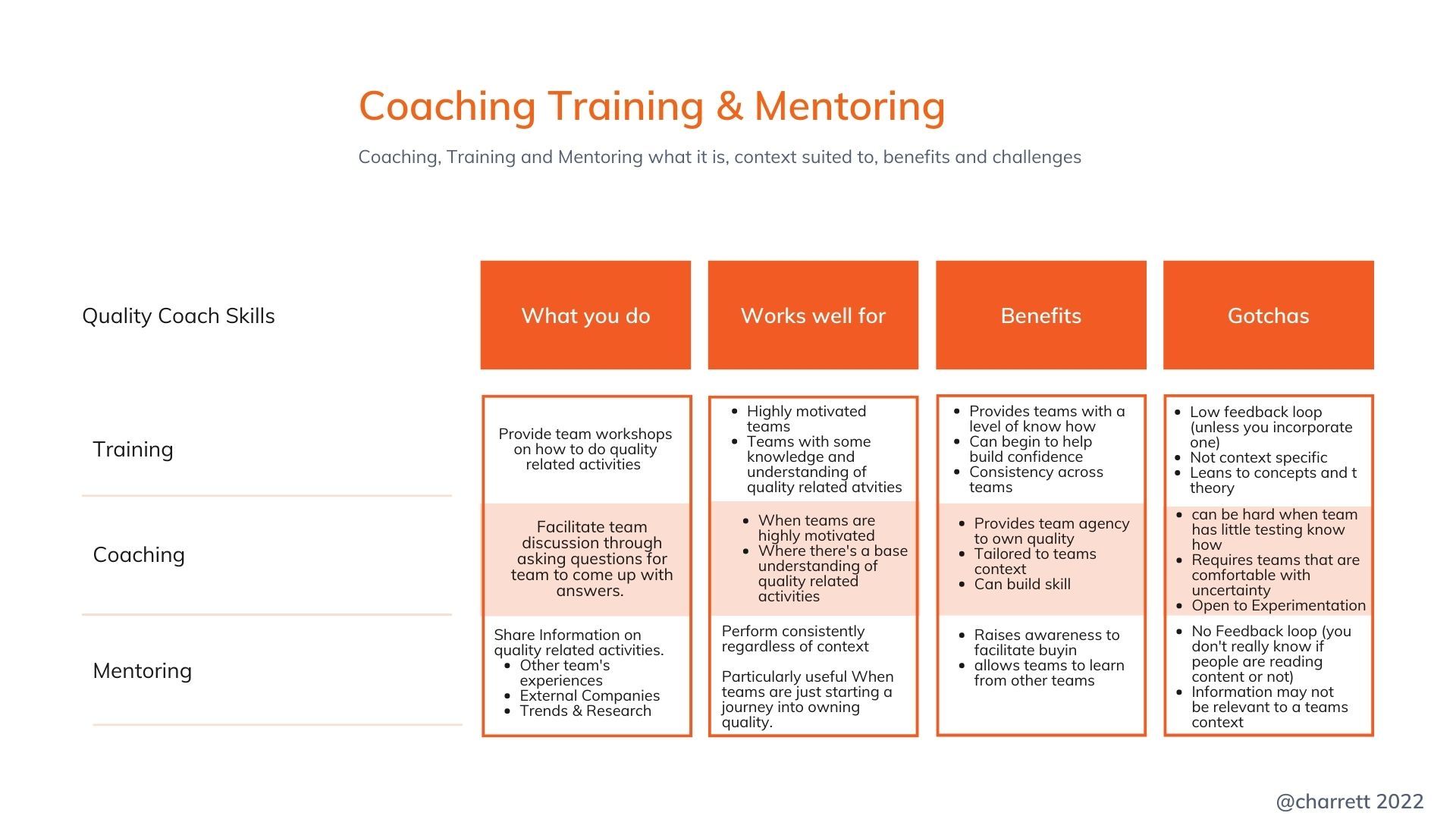
Benefits of Coaching, Training and Mentoring
For a quality coach, teaching methods depend on the team, what they're working on, their abilities and understanding of quality, and how much they buy into owning quality. A quality coach must work with all levels of ability and motivation. Knowing what teaching method is, where it works well, how it benefits the team, and its pitfalls. The table below summarises this information for you.
Quality Coaching is situational
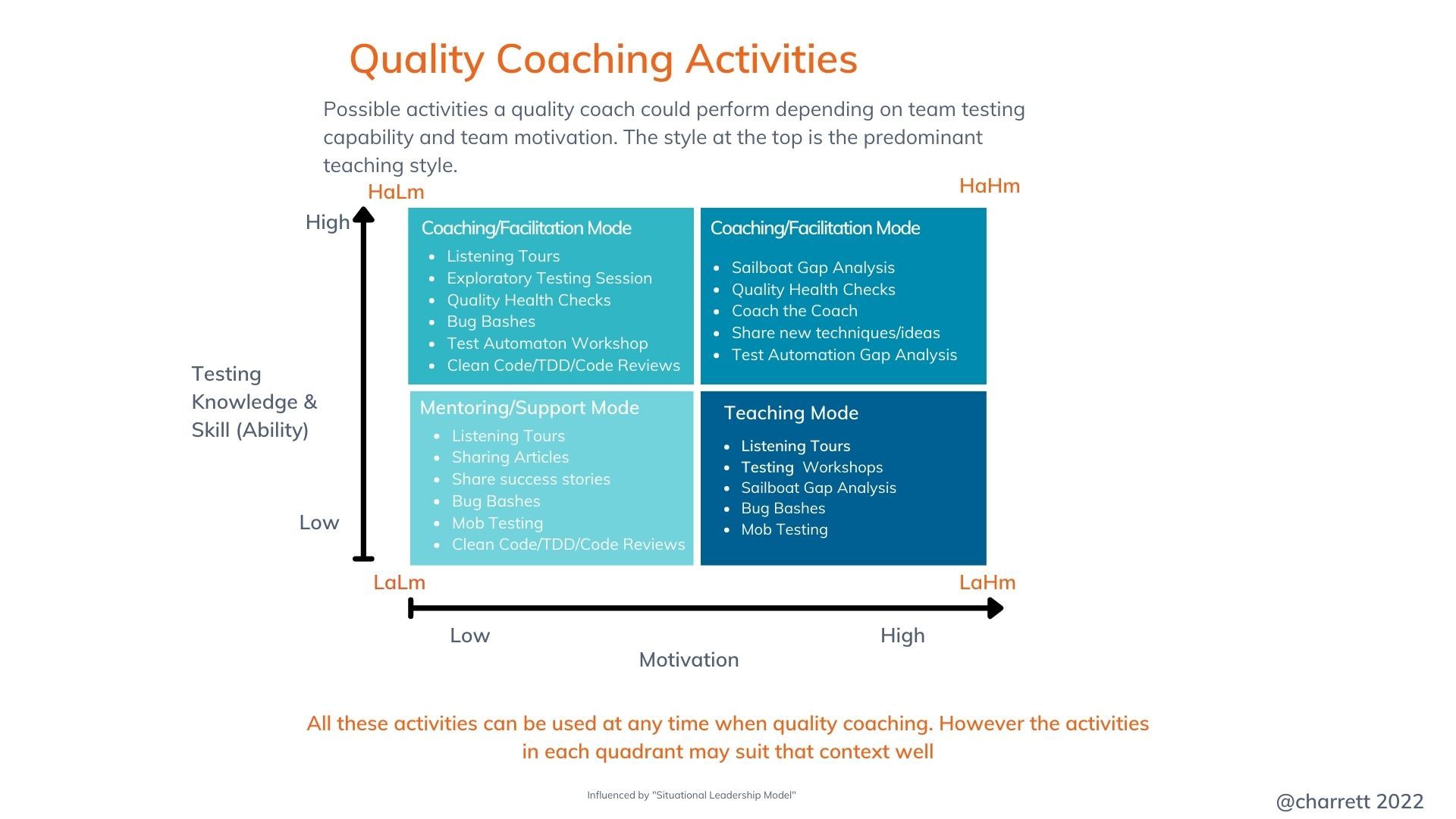
Knowing where a teaching method works well plays a part in knowing when to coach, train or mentor. How motivated a team is to 'own quality' combined with their testing ability largely determines the type of teaching style a quality coach should use.
By loosely applying the situational leadership model that looks to motivation and skill as factors to consider when deciding on appropriate leadership methods, we can create a handy quadrant to help know when to coach, train and mentor and what activities may be useful for that context.
The quadrants below offer potential teaching styles and activities depending on the level of motivation and overall team quality-related skills. Let's take an example where a team starts its journey toward owning quality. They're enthusiastic about this opportunity to influence and direct quality in their team. However, they've not performed much testing before. They need guidance on what testing activities to perform and when they take place. This context falls into the lower right quadrant (LaHm-> Low ability, High motivation). A teaching approach is most appropriate where the team learns some basic concepts such as how to create a test strategy.
However, if that team was sceptical and reluctant to embrace a whole team ownership concept, the team sits in the low left quadrant (LaLm -> Low ability, Low motivation). Here, a mentoring style with a focus on sharing experiences and content helps explain the why and build credibility on a whole team quality approach.
Teams that have a good grounding in quality activities may find a coaching style preferable. Quality Health Checks can also come into play. Where teams are highly motivated, you could even consider having them coach other teams. Listen to your teams to gauge where the enthusiasm exists and use that to build up their ability and skill.
A word on team motivation
Be cautious in how you interpret a team's motivation. There are many reasons why a team may appear unmotivated. It may not be the obvious "our team doesn't want to test". Teams that are under pressure to deliver rapidly may find this extended scope of work daunting. Some may have a fear of 'missing bug', and yes, some will be reluctant to take on testing work as it can be seen as low value, repetitive boring work.2
When motivation is low, try and identify places where even a little enthusiasm exists and start working with the team from there. Test Automation, with its technical emphasis and its promise of reducing boring, repetitive work, can often be a good place to start. Look at the situation from their perspective and begin there.
Another approach for low motivation teams is to perform a gap analysis, identify the team's key concerns, and work to mitigate those risks. Remember, it's the team that owns quality, not you. Their ideas may differ from yours, which to a degree, is totally ok. As much as possible, give them agency. Of course, this isn't always possible if the mandate is driven from the top down.
A word on a team's testing ability
Avoid the assumption that low testing ability implies low motivation. There are many reasons why a team may have little testing ability. It could be that that team has lots of junior engineers who haven't been taught testing at university. Or it could be that in past companies, they've had a tester on the team who was reluctant to share knowledge. Past experience is not an indicator of low motivation.
Final words from a quality coach
There are many factors to consider in knowing what teaching approach to take when assisting a team. As we've discussed here, motivation and ability are two key factors, but you also need to consider your own personal experience and abilities and how you perceive yourself in the role of quality coach. Remaining observant and curious will help you better understand the team's context and considerations.
And there you have it, situational quality coaching.
1 facilitation is the method used to perform team coaching. During my work I often substitute the word team coaching with facilitation.
2 It's very common for teams to have the perception that testing is boring. And yes, testing CAN BE BORING. But it doesn't have to be. Try exploratory testing as a team which can be fun and engaging.
Got a decision to make, a conversation to prep, or a move to work out?
Drop in the real situation. KYM reads it through the Handbook's frameworks and gives you a move you can try.
Open Know Your Move →


Comments ()