Quality Coach Team Operating Model
The hub and spoke model is an effective org structure for a quality coach enabling team
Where do quality coaches fit within an organisational structure? Do they permanently sit within a product team or float across multiple teams? Exactly where do quality coaches reside?
Over the years, I've worked with two models and heard of blended versions of these models. The first is a quality coach permanently embedded in a team. Here, a quality coach's main objective is to work closely with one team and support other teams within a tribe. The quality coach may or may not report to an engineering manager.
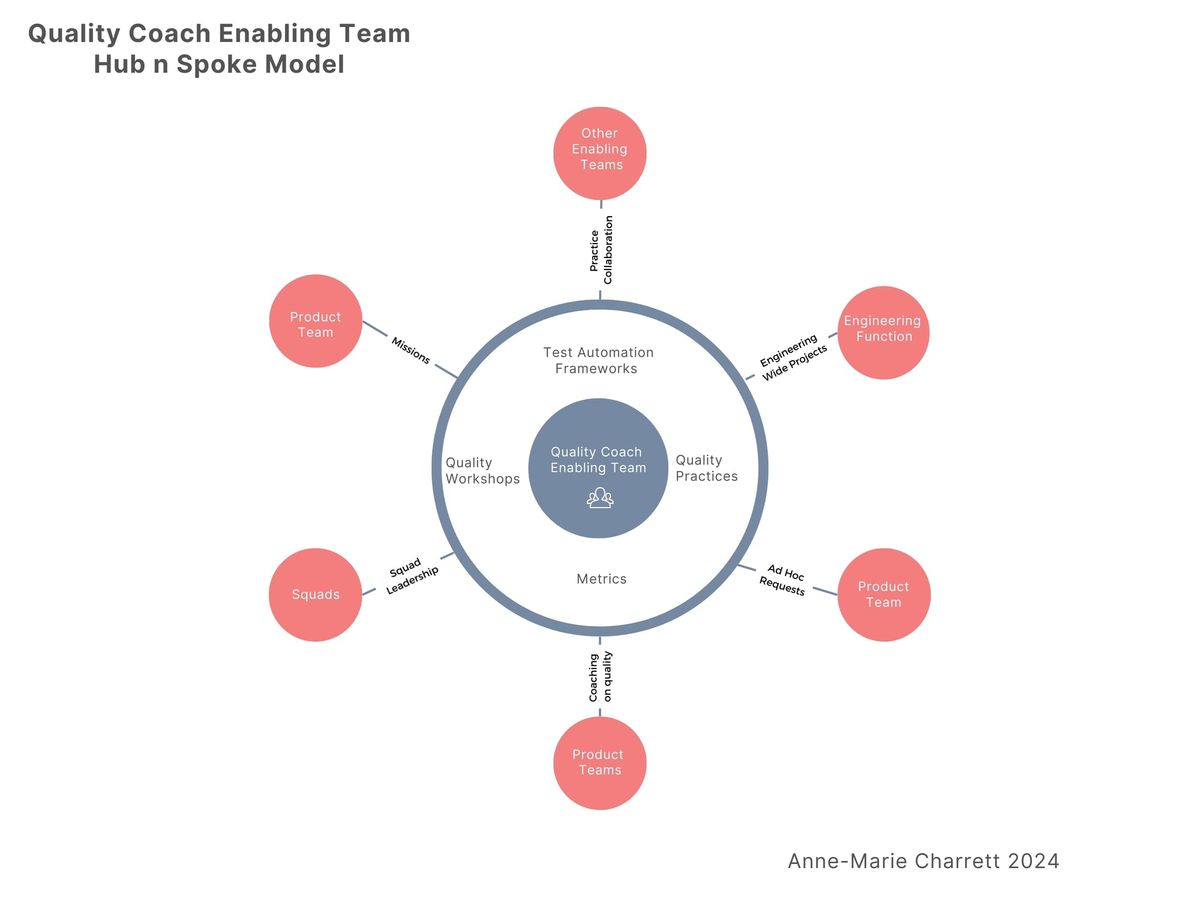
The other option is to have quality coaches sit within an enabling team of quality coaches. The quality coaches have their strategy, backlog, and roadmap. The enabling team's function is to support multiple product teams and tribes by offering quality coaching services. A hub-and-spoke model is a popular and helpful model for this type of team.
The Hub
The hub is internally focused. It has its internal strategy and roadmap executed through a backlog. Backlog tasks such as:
- Test environment, test data strategies.
- North Star vision of testing in production
- Content and Workshop Templates for Quality Coaches to use as needed.
- Identifying measurements and metrics. Tracking progress across engineering.
- Creating career paths for quality coaches
- Creating and maintaining test automation frameworks and tooling
The Spoke
The spoke part of the model is externally focused, interacting with other parts of product engineering. Predominantly, it focuses on coaching and supporting teams, but it also includes:
- Collaboration efforts with Delivery and SRE and Development Practices to develop a holistic approach to quality
- Integrating testing blueprints into repository templates stored in Backstage
- Coaching teams on quality and facilitating workshops
- Ad hoc requests for test data, environment support through a slack channel
- Engineering-wide projects such as SOC2 compliance
- Three-month missions where a coach sits in a team.
Missions
A mission occurs when a quality coach is embedded in a team for a fixed time. Each mission has an objective and a success metric to identify its completion. The maximum time was three months.
The types of activities a quality coach would perform were:
- writing test automation where the coverage was shallow
- helping a new team put together their quality practices and measurements
- supporting teams with complex or critical testing needs (migrations etc)
The overall approach is described below:
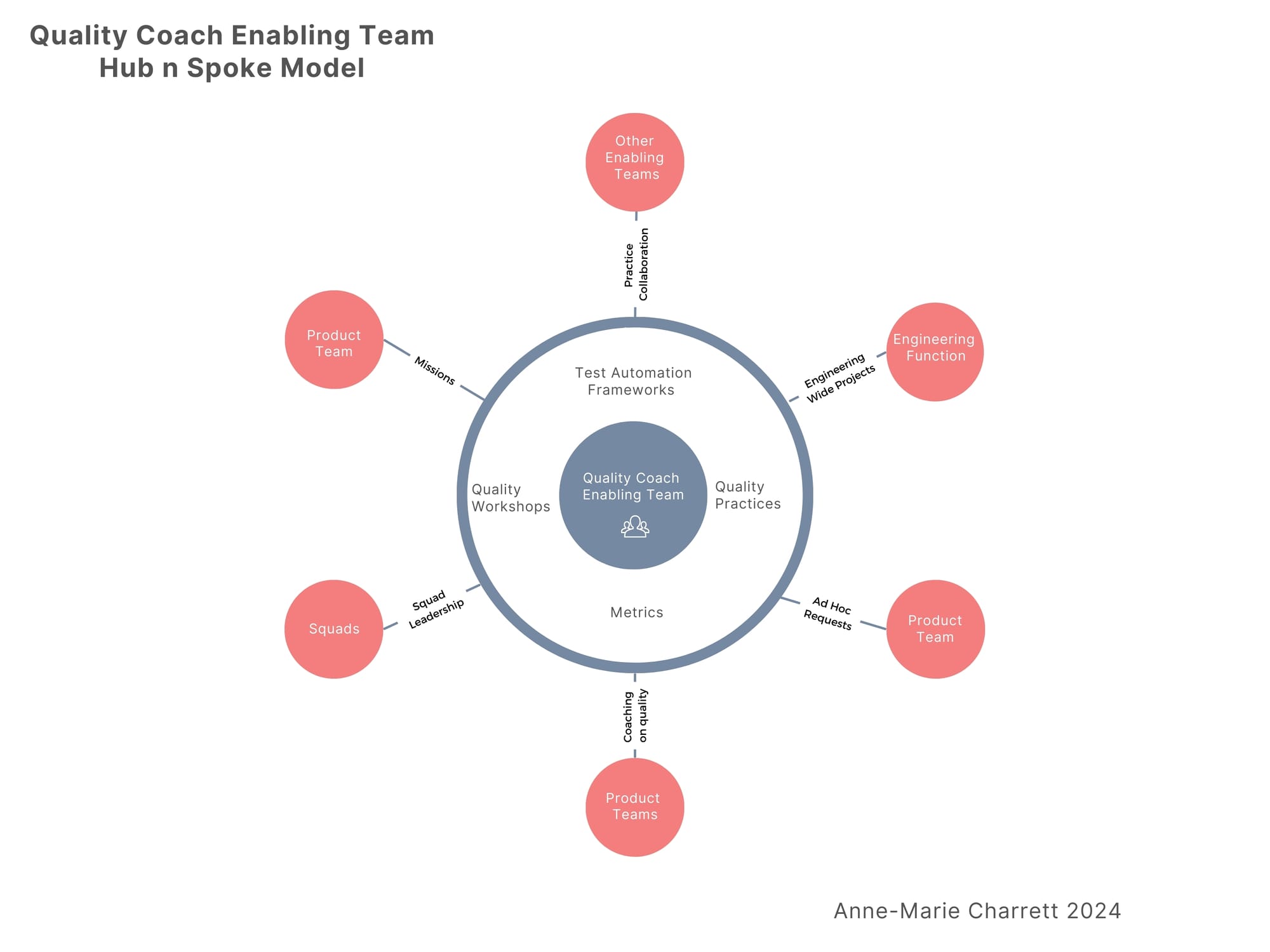
Use the Canva Template link to create your own Hub and Spoke model.
Both approaches have pros and cons. I've found the enabling team incredibly effective and efficient. It creates a sense of community and provides support in a demanding role.
Reporting Lines
It can be difficult to decide who a quality coach reports to. Quality coaches can report to a senior quality professional, engineering managers, or, if senior, directors of engineering.
Most quality coaches favour being managed by a quality coach1.They feel heard and understood. Many engineering managers are uncomfortable managing quality coaches. They are unfamiliar with what success looks like and how to help in their career paths. This can be coached, but with a busy workload, many engineering managers are comfortable handing this responsibility over to a director of quality engineering.
I favour keeping quality coaches' work on a team backlog, holding the quality coach accountable to the engineering manager for completing team tasks, and then having a senior quality professional as a manager who guides them along their career path.
This is something to be discussed with all involved parties.
Do you have a favourite model that works for you?
1 Read Lisa Crispin's comment below for a counterexample of this.
Is this article worth a testimonial? Would you be willing to write one? I've made it super easy to write 😁
Got a decision to make, a conversation to prep, or a move to work out?
Drop in the real situation. KYM reads it through the Handbook's frameworks and gives you a move you can try.
Open Know Your Move →
Comments ()