Staying Sane in a Post Modern Tech world
Before I start, I want to be clear. 2025 was an awesome year. I got to attend some incredible conferences such as Yow!, Agile Testing Days, Testing Talks. Plus, I got to attend a Kent Beck workshop kindly hosted by my work.
I co-led a tutorial with Fiona Charles on expecting to lead quality which was freakin awesome! I plunged into the world of AI and agents, and discovered liberation in what I had first treated with suspicion.
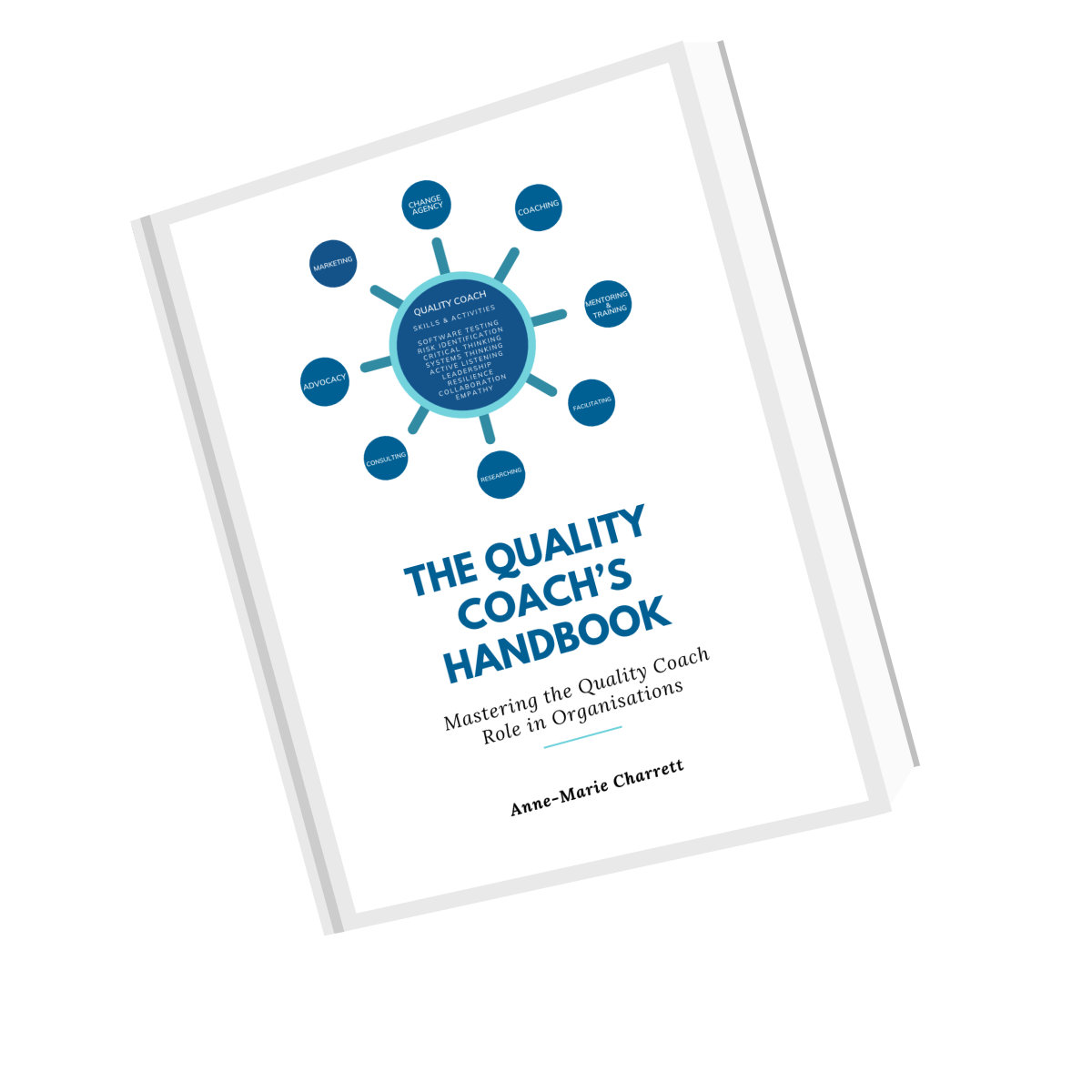
And I published a book. One of my most proud achievements.
2025 was an awesome year. It was also a demanding year.
As many before me know, you don't get a free pass writing a book and working full-time. The effort will impact you. It takes something out of you. And it takes a while for that something to fill up again.
In addition, the organisation I work for is undergoing significant change. Change is great if you are the one delivering it, not so much fun if you're on the receiving end. I experienced both.
Like many of us, I find the reality of AI in our lives deeply unsettling. The fun of playing with a shiny, exciting toy contrasts with the consequences it will have for our industry and our lives.
Add extensive international travel, and it's an understatement that I ended the year fatigued.
Fortunately, I've had the opportunity to take a long break, which has been a real blessing. I have done little for weeks other than reading trashy novels and swimming in the ocean. The clincher? I didn't worry about anything. I didn't worry because I realised I really needed this time. I didn't care whether I was social (well, I did a little) or whether the house was messy (it was). I didn't analyse my day or my relationships, and I didn't think about work. This state of 'just doing' has been soul-nourishing.
I believe that we are witnessing the birth of a new paradigm within software engineering. New paradigms emerge when old models cease to function, and right now, there's a whole bunch of us scratching our heads, wondering how the hell we got here1. Burnout is the new epidemic, and quiet quitting has entered our dictionaries. Job losses are on the rise, and many people are lying low, hoping that somehow things will turn around. AI has entered the workforce, creating instability and uncertainty for the future of software engineering.
Of course, software engineering doesn't live in a bubble, and we are currently experiencing change at a societal level that exacerbates our anxiety and stress. Climate change, new world orders, security threats, and the renewed emphasis on 'the other' make us question how tomorrow will play out. I find it hard not to think about how my local beach may or may not exist when I go down for a swim.
When things "feel" chaotic and out of control, our anxiety rises. Simple decisions start becoming difficult. The overwhelm is real.
In 2010, the philosopher Byung-Chul Han wrote a book titled The Burnout Society2, which hypothesises that we no longer live in a disciplinary society in which command-and-control is the order of the day. Instead, we live in an achievement-oriented one. We require that our work be meaningful and internally motivated rather than being told what to do. We achieve our goals. We are also responsible for any failure.
But logically this can't be true. We work within systems where chaos is often imposed on us, without regard for the achievements that seem so vital to the system's outcomes. Just as the "crying Indian"3 campaign was used to promote litter consciousness while giving waste-polluting companies a free pass on accountability, we in software engineering have somehow become accountable for outcomes we can't possibly achieve without real agency.
Achievement-oriented subjects who work in a chaotic system will never meet our internal expectations. Consequently, we attribute the failure to ourselves. We believe we're not resilient enough. We think we haven't established the psychological safety teams needed to achieve outcomes. We blame ourselves for indecisiveness and/or disorganisation when, in reality, it's impossible to sustain change amid chaos.
What if the best we can do in these situations is nothing?
Rabbits confronted with headlights often stand stock-still. Humans read this behaviour as fragile and stupid. But is that true? What if, in the face of extreme obstacles, rabbits know the best chance of survival is to do nothing and wait for the danger to pass?
At work, what would this 'do nothing' look like? Doing nothing is not failing to turn up. It's not quiet quitting. It's not giving up because everything is impossible and too hard.
By doing nothing, I mean doing our work without ascribing value or meaning to it.
Doing nothing means fulfilling your contractual obligations, nothing more, nothing less. It means ignoring outcomes that are impossible to achieve. Not because people are incapable, but because the system is so stacked up that it is impossible to intentionally achieve them.
The good news is that this now means you don't need to be a rock star; you don't need to be overinvested in improving your organisation. You are simply invested in performing your contractual tasks. You see the hyperbole for what it is and focus on the task at hand.
Working in the moment, attending to the task at hand, and letting go of the inner voice that critiques is hard work. Intentionally, 'doing nothing' is hard work. It requires catching yourself in the moment and mentally walking away from the chatter. For me, that requires meditation, taking proper breaks, not eating at my desk, and not working past certain hours. It's about consciously adding 'trivial' tasks to my day, such as hanging out my washing, taking a midday nap, and going for a walk for its own sake. It's about doing some weeding in the garden, or reading a trashy novel. Motivation is irrelevant here. What's important is balance.
A useful frame here is the idea of a 'full tank' - that we have activities that stress our bodies and others that relax them. Surprisingly, coding - even when you're in the zone - is a stressor. So is going to the gym, regardless of the dopamine hit. Knowing which activities deplete and which replenish can help you find balance. If you're interested in this, check out Tank4.
Burnout is your body telling you to wake up and change something. Don't ignore this opportunity to tweak your life and your perspective.
Because in doing nothing, we are in fact doing something.
It took me around 2 days to research and write this article. If it saved you time or gave you something to think about, tips are appreciated 😁
References & Further Reading
1 Articles on broken systems
 Michelle Redfern
An article I recently wrote on systems and working inside them:
 Anne-Marie Charrett
2 I found this book hard to read. This article is far more digestible.
3Keep America Beautiful was founded by packaging corporations (Coca-Cola, American Can Company, etc.) in 1953. The 1971 "Crying Indian" ad shifted blame for pollution from industry to individuals - "People start pollution. People can stop it." The actor wasn't even Native American. The campaign successfully deflected attention from corporate responsibility onto consumer guilt for decades.
4Tank is a framework and tool that helps you understand which activities stress your body and which restore it. I've found it useful for avoiding burnout.



Comments ()