Build a culture of learning by amplifying team wins
Neil Younger talks about amplifying success to drive change in this latest quality coach book article

There are many formats for teams to celebrate success and ways of working. The approach described in this article takes the additional step of thinking where practice could be shared and, importantly, attempts to tie that back to the department or business's collective learning and development goals. In this way, sharing becomes a deliberate act targeting the needs of others and the business.
The work of Dr Steven Spear in his book ‘The High Velocity Edge’ explains how a learning organisation brings business success in that new discovery of local knowledge and improvements are turned into global improvements.
As a coach accelerating the capabilities of others is an important part of your role and from a quality perspective this follows the principe of being a force multiplier.
What is it?
A simple team-centric workshop that can be run in an hour or less.
It focuses on what the team is good at from a technical or process point of view and when applied to an organisation can to empower other teams with their experience.
At the team level it can help support the foundations of experimentation, growth and improvements while celebrating their successes.
This approach can be used for any department within an organisation and isn’t specially related to the software or engineering examples used in the article.
As with most practices that involve sharing, the impact of this approach expands as more teams use it, supporting each other to level up in the process.
Its principles centre around:
- What a team is good at (Technical and Process)
- Where can they share this (At which level of the business)
- How can they share this
Why might you need it?
- You want to develop a consistent and simple approach that can be used for one to many teams.
- You already have a culture around learning, development, and sharing but want a way to relate this to your department or company’s areas of growth.
- You are building a culture of what good looks like for your business and want this to be a collaborative process.
- You find that while teams are sharing how they work others are finding it difficult to categorise and discover this learning to be able to make use of it themselves.
- Your company is scaling and it is becoming harder for teams to learn and share with each other.
- You have more than one team and are starting to want to accelerate team-level improvements across the department.
How to run a workshop
In the examples below, we have used a virtual Miro board but the design works just as well on a physical whiteboard.
The format is in three simple parts.
- Identify what the team is great at (Technical & Process)
- Identify where can share it (From the Team to the world!)
- Decide which, and how, key suggestions will be shared
📹 If a video explanation is more your thing, please see this 5-minute explanation.
1 ) Identify what the team is great at (Technical & Process)
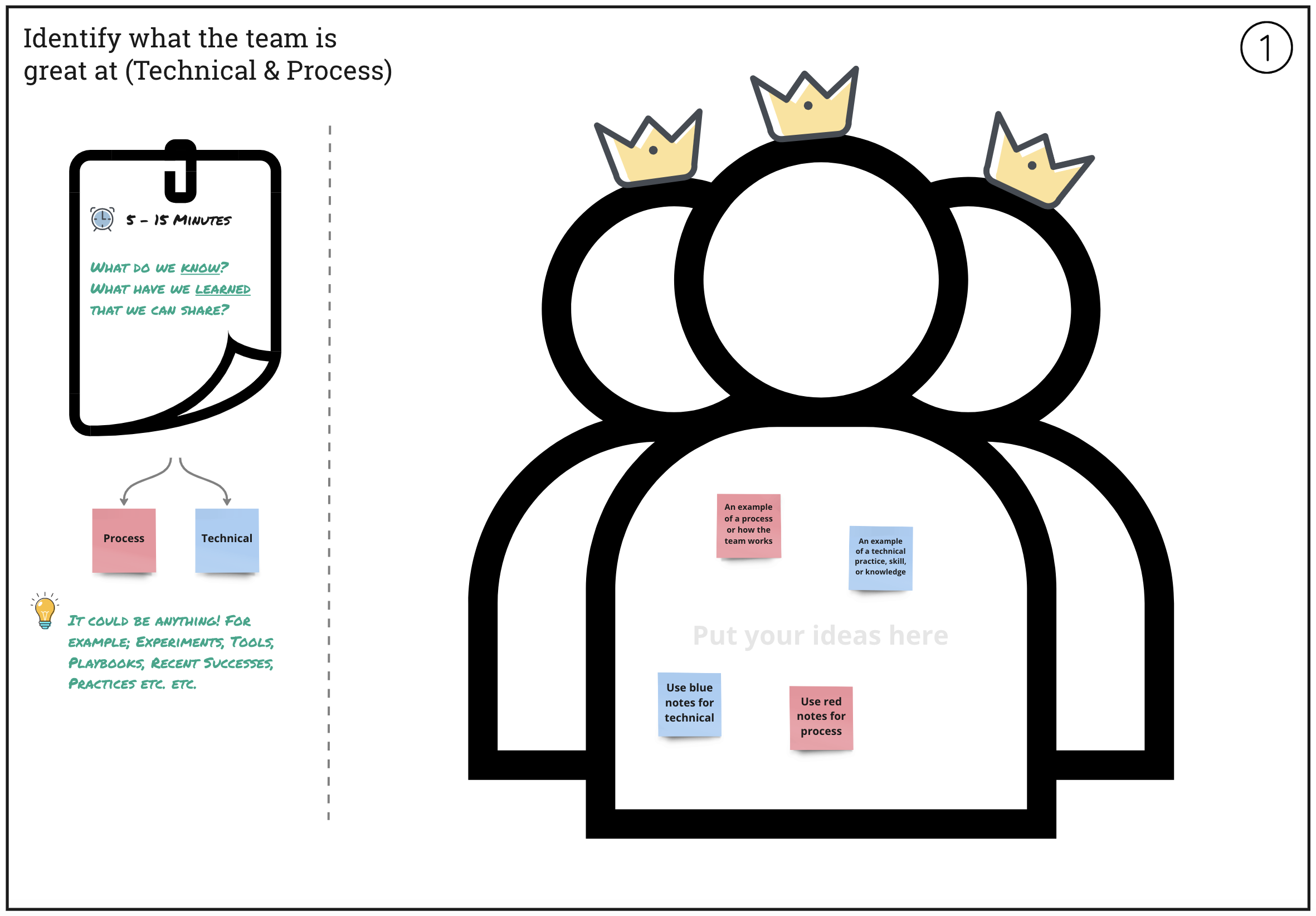
⏰ How long: Spend about 5-15 minutes. Stop when people have run out of ideas.
- Ask the team to brainstorm ideas. Add these ideas to two different coloured stickie notes. We are using blue and red in our example.
- For technical activities, use the blue cards and the red for process activities. Everything should be able to be classified as either technical or process.
- Encourage the team to focus on ‘What do we know’ and ‘What have we learned that we can share’.
🗒️ Facilitator notes: Consider the timeframe you apply this to. You might want to restrict suggestions to the last three months (or the last time you ran the workshop), or perhaps since the team was formed, or only cover suggestions from the most recent project or block of work.
🗒️ Facilitator notes: Sometimes, a team will only focus on their technical ability and it is worth reminding them that their ways of working are equally important. They might worry that these aren’t ‘perfect’ or unique enough to share with others but each team will be on its own journey, and their experiences will always be valuable to others.
💡Example: Maybe you release features using ‘feature flags’ and that has meant you have more control over product changes.
2) Identify where they can share it (From the Team to the world!)
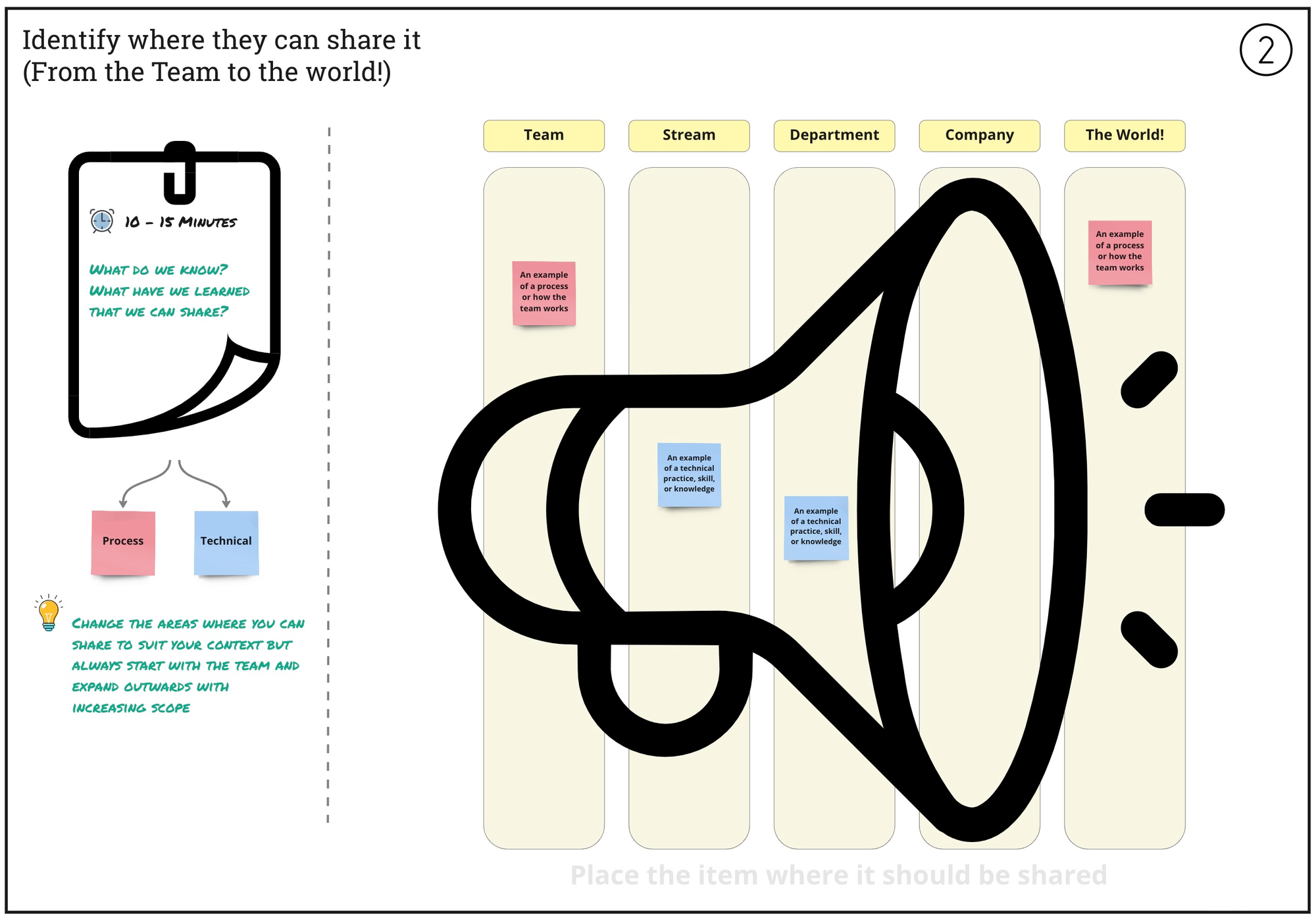
⏰ How long: Spend about 10-15 minutes, depending on the number of ideas generated from the previous step.
- For each of the ideas generated from the previous step, decide where they should be shared. You can move or duplicate the stickie notes; it's up to you.
- You might want to share some items in multiple places, so duplication is helpful here.
🗒️ Facilitator notes: Change the sections (Team, Stream, Department, Company, The World) to suit your organisation and context. It doesn’t matter what they are but they should be relevant to you and your organisation. Maybe you don’t have streams of work but do have projects that multiple teams contribute to, for example. Importantly each section should extend the reach of the previous, so the narrowest scope is on the left and the largest scope on the right.
💡Example: Maybe you want to tell the department about how you engage with your stakeholders. Or maybe you want to tell the company how you approach learning as a team activity.
3) Decide which, and how, key suggestions will be shared
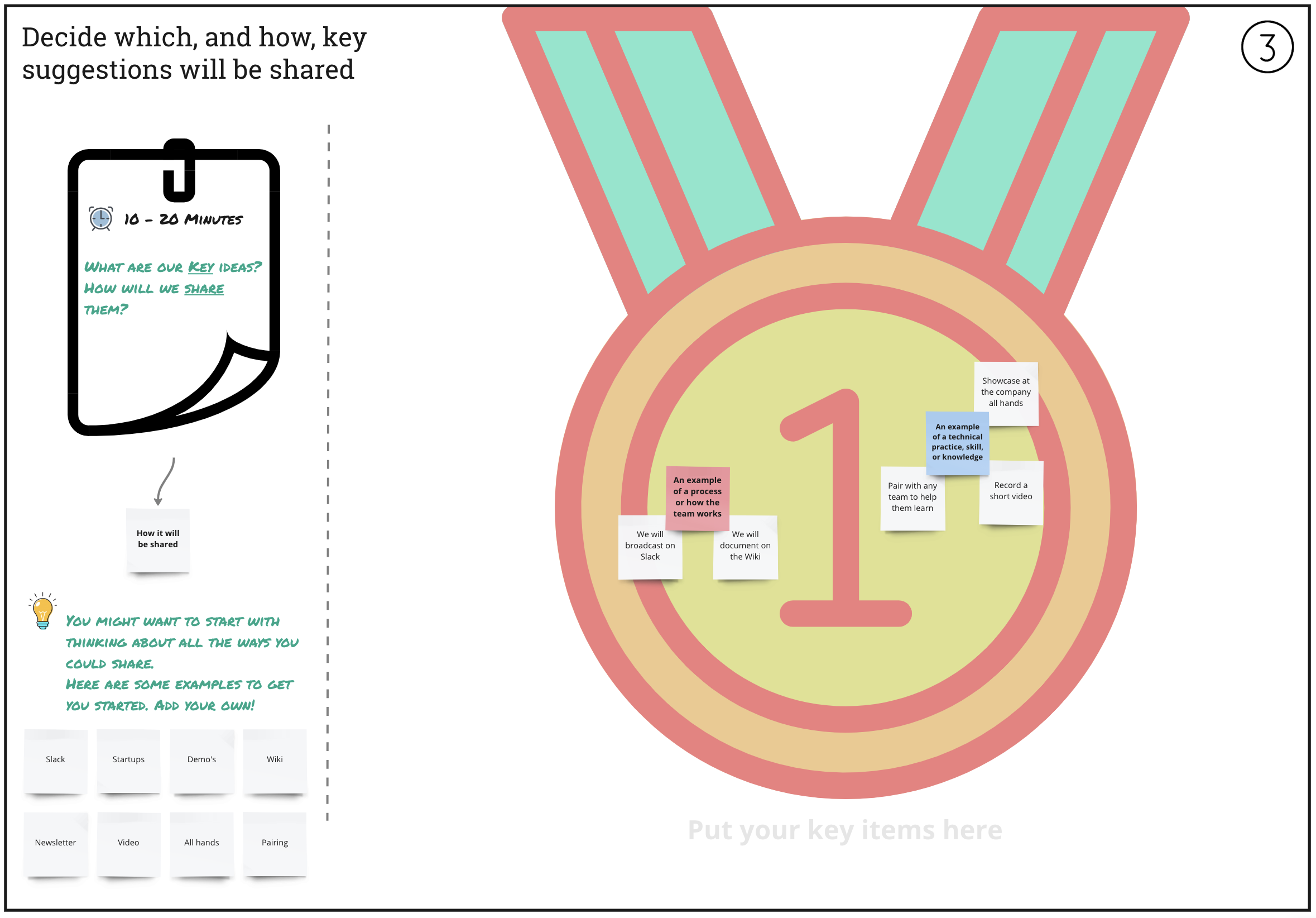
⏰ How long: Spend about 10-20 minutes with the aim to identify 2-6 key items.
- For each of the ideas generated from the previous step, decide which are the key ones to share with other people. This is helpful if you have generated a lot of ideas. Concentrating on the ones that have the most impact might be useful. It is suggested to duplicate stickie notes from the previous step so as to keep a reference on where you are sharing them.
- After selecting the key ideas, think about how you can share them. Add these as additional stickie notes, shown in white in our example.
- Encourage the team to add their own ideas on how to share things. Some have been added for inspiration, but many more opportunities will not be listed.
- When finished, you might want to add these key areas as items on your next sprint.
🗒️ Facilitator notes: It can help to spend a few minutes at the start brainstorming all the available ways, for your context, that you can share information.
🗒️ Facilitator notes: Depending on the number of suggestions generated, you might decide to share them all. The important thing to consider is the impact of those suggestions, especially if many of them exist. Asking the team to identify key ones helps them to focus on the most impactful ideas. Limiting the shared suggestions can also help reduce the team's load and make it feel less like a chore and more like a celebration.
🗒️ Facilitator notes: Commit to sharing as a team, perhaps assigning tasks within the session itself.
💡Example: Maybe you want to share your idea around feature flags with the whole of the department and have decided that this will be via broadcasting on Slack and further documentation on a Wiki.
Categorising the ‘wins’ to support an improvement program
The approach described above works well for teams to encourage a sharing culture and can be used exactly as described.
If you would also like to use it to help enable a learning culture and to tie it back to the collective improvement and development goals of the department or business, assuming that you have them, then an additional step is needed in the workshop.
To provide a practical software engineering example of improvement areas, we will use the following categories inspired by the ‘Quality Culture Transition Guide’
- Testing Breadth
- Quality and Test Ownership
- Technical Debt and Maintenance
- Code Quality and Tools
- Customer Data Analysis (Analytics)
- Development Approach
- Learning & Improvement
- Customer Success
- Leadership Emphasis
You might want to use these, have your own already, or be in a context other than software engineering.
To apply this to the workshop, we would simply take the additional step of classifying each idea chosen to be shared using the categories above.
💡Example: So, in our previous example of sharing how we release under feature flags, we would classify this as a ‘Development Approach’.
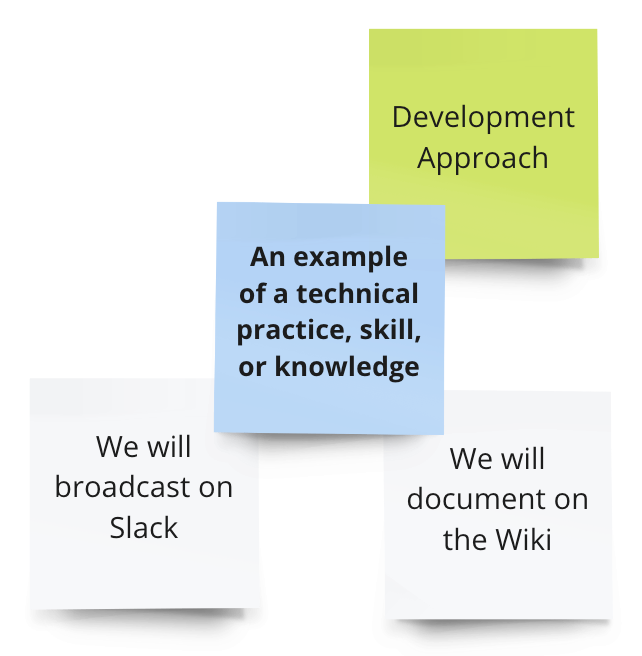
By doing so, we start to create a library of good practices and technical abilities categorised to the department or business need. This enables and makes it easier for, all teams to pull from these groups of practices when they identify an area they would like to improve in.
Make it your own
The ideas presented here can be used as described, adapted, and amended to suit your situation. Remember, this is about celebrating with a team and inspiring them and others to share and learn together. The principles are simple, yet powerful when applied to a department or organisation and, coupled with other initiatives, can lead to, or support, a culture of growth and improvement.
Decide when and how often you want to run these. Some teams treat it as a separate exercise, while others use it as a replacement for an existing retrospective. Either works fine, and the advantage of using an already existing retrospective meeting means no additional load on people’s calendars. Doing it this way, you could arrange one per quarter with very little overhead.
Running this workshop on a cadence can help to build a team’s ‘muscle memory when it comes to learning and sharing, so much so that, in time, the workshop isn’t needed, and it just becomes how the team works.
Most importantly, have fun, and make sure that teams have the time and space for activities that support the growth that ultimately makes them, and the business, more successful.
Neil has kindly donated his fee for writing this article to 2 quality coach subscriptions - Watch out for this month's newsletter if you wish to nominate someone.
Got a decision to make, a conversation to prep, or a move to work out?
Drop in the real situation. KYM reads it through the Handbook's frameworks and gives you a move you can try.
Open Know Your Move →

Comments ()