Building Cross-Functional expertise in a team
Product teams often overlook cross-functional requirements. Here's one way to help them consider those quality attributes.
Teams often focus on functional requirements during sprint planning, refinement, or three amigos, overlooking cross-functional requirements (CFRs).
Performance, security, observability, and accessibility are commonly overlooked cross-functional requirements. The problem goes deeper, though. Team members differ in opinion on what these terms mean and how much they matter.
Cross-Functional Requirements Workshop
I will share a workshop I have used on many teams to help combat this challenge.
The workshop facilitates discussions with the teams to achieve a common understanding of cross-functional requirements and why we should care about them. I used Miro or Mural to do this. You could include developers, testers, coaches, product owners, business analysts, and platform team members.
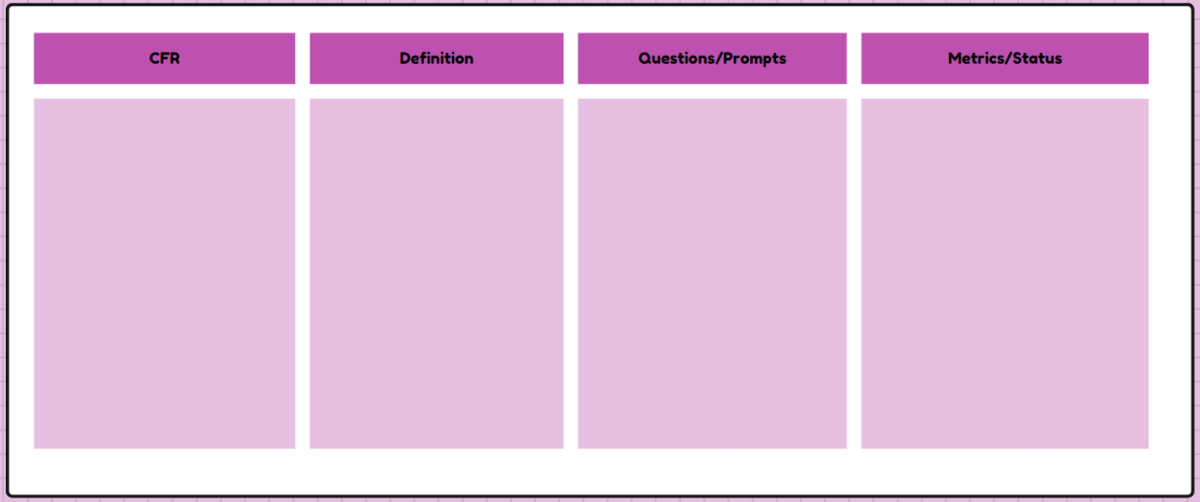
Below is a template I used in the workshop.

List CFR's
I ask the team members to choose the cross-functional requirements for a particular product the team is working on. You will notice a long list and repeated CFRs, as every team member might add every CFR they can think of. This list is not a prioritised list yet.
Define the terms
Moving to the next part of the workshop, ask the team to define each CFR. Whenever I have done this on any team, I have observed that everyone on the team either had a different definition or the exact definition but with different terminology or understanding.
Each time I did this exercise, the team's feedback was that they never realised each one of them had such a different understanding. Another observation is that sometimes teams won't agree on one definition, which is okay, in my opinion. As long as it's captured and the entire team understands and agrees.

Prioritising Cross-Functional Requirements
Now that you have a list and definitions, the next step is to prioritise or look for what's most relevant to the team's work. The product owner can drive the discussion to help the team prioritise this list.
The next step is to help the team explore more detail. I ask the team to create prompt questions for each CFR. This exercise helps the team consider what they need to consider. For example, one prompt question for security testing might be, "How will user identities be verified and authenticated?"
Each team member can add prompt questions to the list. Encourage as many prompt questions as possible.

Select your top 3 to 5 prompts for each CFR. These will then serve as a guide for prompt discussions during refinement.
The following section discusses optional metrics in the template that may not apply to all CFRs. You can define team metrics you want to capture and evaluate for each CFR. When it's time to do a demo, you can use the metrics or status of each CFR to show what has been implemented and the current status of the implementation details.
This is another way to coach and enable the team to think about CFRs instead of teams always relying on a quality engineer or tester.
Reuse the CFR Prompts
Now that you have a prioritised list of CFR, definitions, and prompts, this becomes your template. It can be published and added to a Jira user story as a template for every story, making it handy for the team to use while reviewing each story.
I have used this on many teams, and it worked well for teams to know what questions to ask to start discussions. Knowing that the entire team has the same understanding makes it much more manageable.



Comments ()